Fracture Repairs for Pets
The primary objective of fracture repair is to provide rigid stability to the bone and promote proper bone union. This stability can be achieved through internal or external fixation implants, both of which play a crucial role in ensuring successful bone healing. At Elizavet, we specialise in fracture repair for pets, offering advanced surgical techniques and expert orthopaedic care. Our patients come from across London including areas like Maida Vale and Camden, and further afield. Our treatments are individually tailored to ensure safe and successful bone healing.
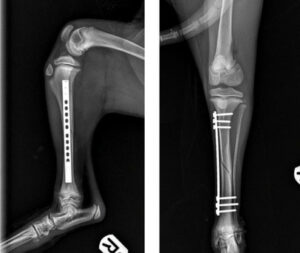
Fracture repair planning and methods
Fracture planning and owner consultation process
Successful fracture repair requires careful planning and consideration of various factors between our surgeons and clients. Once the patient is stabilised but before we operate, we analyse and then summarise the approach we will take using a fracture assessment scorecard that delivers a number based on three elements:
- Mechanical Factors – to determine implant strength based on fracture type and location.
- Biological Factors – to assess bone healing potential considering age, health, and nutrition.
- Clinical Factors – that involve understanding and agreeing what the most appropriate approach is for the patient and how the client will need to participate. This includes a discussion around post-operative care and follow-up visits.
The assessment score allows us to predict the likelihood of delayed or non-union fractures, which could compromise recovery. Once we have the score we can plan risk factor mitigations with clients accordingly.
Three approaches to fracture repair in cats and dogs
In most cases, internal implants remain in place permanently and do not require additional surgery. However, on rare occasions, irritation or infection may occur, necessitating implant removal.
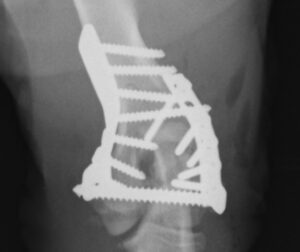
Internal fixation involves placing a metallic implant beneath the skin to stabilise the bone. Commonly used internal fixation devices include:
- Pins
- Plates
- Screws
A wide variety of implants are available and the choice depends on factors such as the surgeon’s preference and the specific fracture type. Internal fixation provides excellent stability, allowing faster and more effective healing.
External implants are removed once bone healing is confirmed, usually between 4–8 weeks. Great care is taken during the removal process to maintain stability and minimise discomfort.
External fixation is achieved using devices that penetrate the skin and hold the bone securely in place. These typically include:
- Pins connected to an external metallic bar
- Circular external fixators
This method stabilises fractures without the need for invasive surgery, although it requires regular maintenance to prevent infection and ensure successful healing.
Fracture healing can also be supported using external bandages and splints. While these methods are less invasive, they can pose risks such as:
- Delayed or non-union of the bone
- Poor limb immobilisation
- Sedation required for bandage changes
Enhancing fracture healing success
To maximise healing success and reduce complications, the following measures are recommended:
- Comprehensive preoperative blood tests
- Selecting the most appropriate implant type based on fracture classification
- Ensuring strict adherence to post-operative care instructions at home
Owners receive detailed discharge leaflets with step-by-step post-operative guidance. By following these instructions, pet owners can support their pet’s recovery and ensure successful healing.
Early implant removal and complications
In very young animals, early implant removal may be required as their bones heal faster. Complications are rare but may include infections, which are generally treated with antibiotics. Occasionally, implant removal may still be needed after healing.
Another potential issue is implant rupture, particularly in complex (comminuted) fractures. Sudden jumping or running before full healing may cause bending or breakage of implants, requiring revision surgery. Strict rest and controlled exercise are essential to ensure complete bone recovery.
Serving North London & beyond
At Elizavet, we welcome pet fracture repair referrals from pet owners and referring vet practices from across North London and beyond. If you’d like to discuss fracture repair options with one of our surgeons, please contact us, or if you’re ready please …